Gemini 3.5 Flash-Lite: Google's Cheapest Model Undercuts 3.6 Flash by 5x on Input

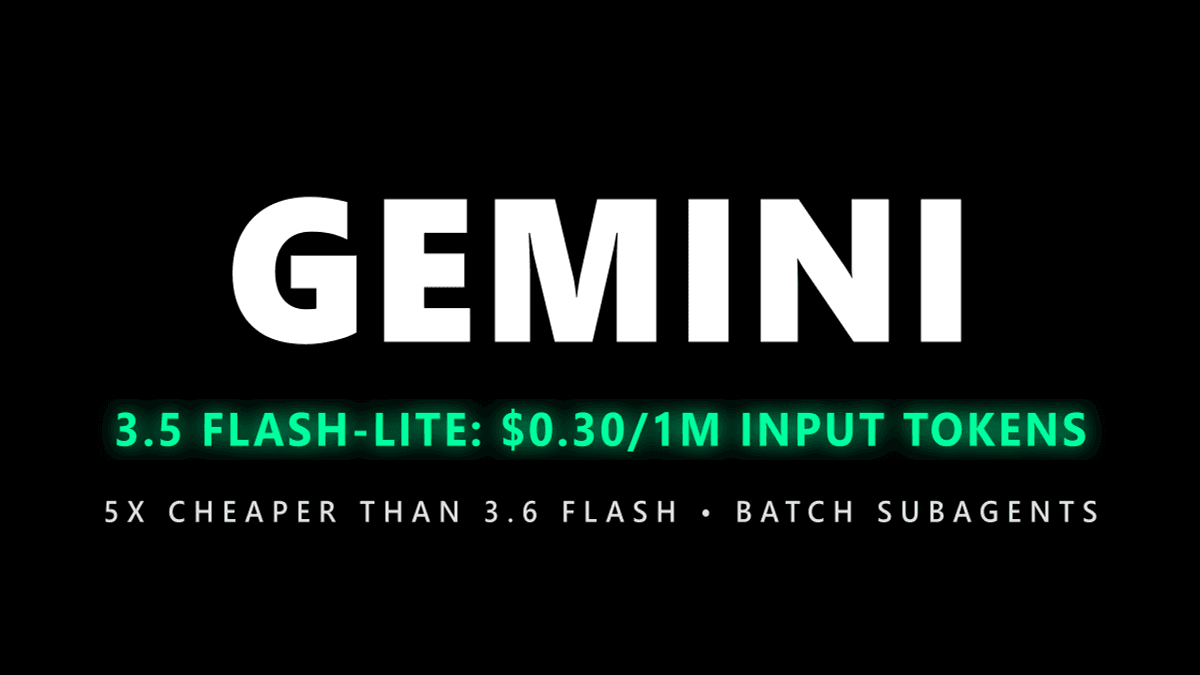
Google DeepMind released Gemini 3.5 Flash-Lite on July 21, alongside Gemini 3.6 Flash and a restricted security model, positioning it as the budget entry point of the Flash family.
Flash-Lite costs $0.30 per million input tokens and $2.50 per million output — roughly a fifth of 3.6 Flash's input price and a third of its output price. It keeps the full 1-million-token context window shared across the Flash lineup, accepts text, image, speech, and video input, and scores 36 on the Artificial Analysis Intelligence Index, well above the median for models in its price tier. Output speed lands near the top of Artificial Analysis's rankings at over 460 tokens per second.
The tradeoffs show up outside the headline numbers. Long-context recall on GDM-MRCR v2 comes in at 72.2%, a sizable drop from 3.6 Flash's 91.8%, meaning the million-token window is present but less reliable at the far end. Time-to-first-token also runs long for a "fast" model — Google's own comparisons put it around 6-12 seconds depending on thinking mode, which makes it better suited to background batch jobs than live chat.
Google is pitching Flash-Lite for exactly that kind of work: high-volume, low-reasoning tasks like document processing, translation, search grounding, and subagents that handle one narrow job inside a larger multi-agent pipeline. It's a continuation of Google's pattern with 3.1 Flash-Lite before it — rather than compete on flagship reasoning, Google is pushing hardest on the tier where enterprises run the largest call volumes and price per task matters more than peak intelligence.