Meta Muse Spark 1.3 Deep Dive: 75.4% DeepSWE Victory, 20% Tool-Call Reduction, and the $0.10 Contributor Play

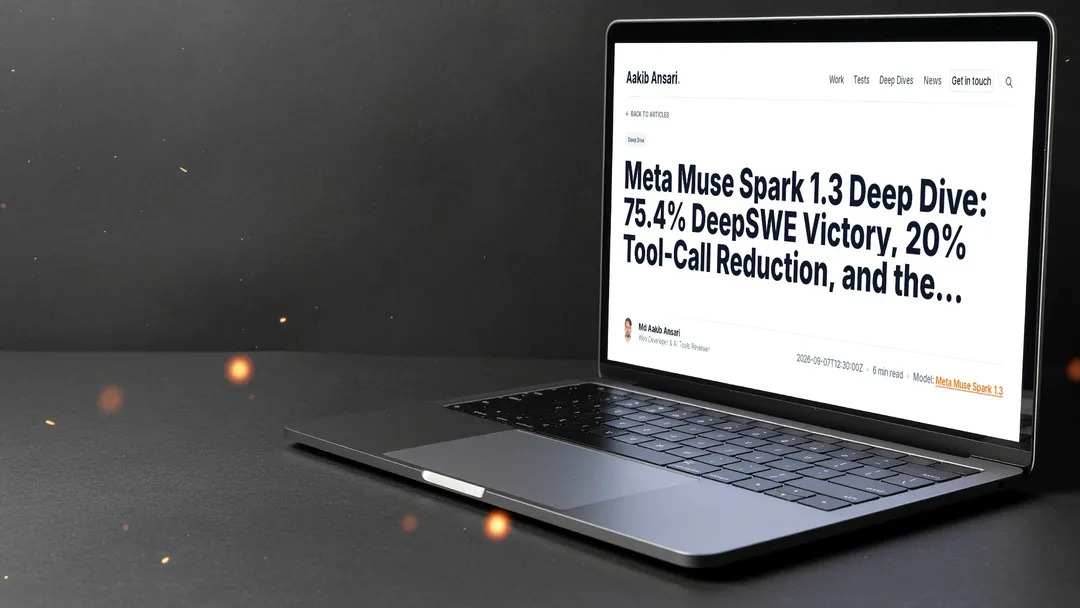
When Meta Chief AI Officer Alexandr Wang spoke to Bloomberg and Axios on September 3, 2026, he bypassed the usual promotional fanfare to deliver a blunt message: Meta's flagship model line is no longer trailing frontier labs in software engineering. With the deployment of Muse Spark 1.3 across the Meta Model API and Muse Code, Meta Superintelligence Labs has delivered a foundation model engineered not for academic quizzes, but for relentless, multi-file agentic coding loops. The release marks Meta's third major frontier iteration in five months, underscoring an accelerating cadence that directly challenges OpenAI's newly shipped GPT-6 Astra and Anthropic's Claude Fable 5.1.
Vitals & Architecture Specifications
| Specification | Details | |---|---| | Provider | Meta Superintelligence Labs | | Model Identifier | muse-spark-1.3 (Standard) / muse-spark-1.3-contributor (Data-Sharing) | | Architecture Tier | Proprietary dense multimodal agent foundation | | Context Window | 1,048,576 tokens (1M native) | | Max Generation Limit | 65,536 output tokens per request | | Multimodal Modalities | Text, Code, High-Resolution Images | | Tool-Calling Efficiency | ~20% fewer tool calls, ~25% fewer tokens vs Muse Spark 1.2 | | Generation Speed | 182 tokens per second (Measured by Artificial Analysis) | | Contributor Input / Output | $0.10 / $0.20 per million tokens (with training opt-in) | | Standard xhigh Input / Output | $1.25 / $4.25 per million tokens | | Prompt Caching Reads | $0.15 per million tokens (88% discount on standard tier) | | Developer Availability | Meta Model API, Muse Code, OpenRouter |
Benchmark Breakdown: DeepSWE 1.1 and Long-Horizon Coding
Evaluations released by Meta AI Research and corroborated by DataCamp and Flowtivity highlight significant gains concentrated in developer tooling:
- DeepSWE v1.1 (Self-Reported by Meta AI Research): Muse Spark 1.3 scored 75.4% on end-to-end repository problem resolution, narrowly overtaking Claude Opus 5 (74.0%) and OpenAI's [GPT-5.6 Sol](/models/gpt-5-6-sol) (73.0%). The benchmark tests an agent's capability to diagnose GitHub issues, navigate inter-module dependencies, draft multi-file patches, and pass validation suites without human intervention.
- Terminal-Bench 2.1: The model recorded 88.8%, tying GPT-5.6 Sol and demonstrating reliable command-line syntax generation and compiler triage.
- MRCR Long-Context Retrieval: On the Multi-Round Contextual Retrieval (MRCR) benchmark, Muse Spark 1.3 scored 98.5% across the 256K–512K context window and 98.1% up to 1M tokens, outperforming GPT-5.6 Sol (91.5% and 73.8%).
- Artificial Analysis Intelligence Index (Independent Third-Party): Independent testing by Artificial Analysis awarded the standard xhigh variant an Intelligence Index score of 61 (with the preview max tier reaching 62), placing it second only to Anthropic's Opus and Fable tiers while sustaining high throughput at 182 tokens per second.
- Where It Trails (Knowledge & General Autonomy): Meta's own technical report acknowledged areas where competitors maintain an edge: on professional tool evaluation (JobBench), Muse Spark 1.3 scored 64.9% (beating GPT-5.6 Sol's 45.4% but trailing Opus 5's 65.7%), while computer use on OSWorld 2.0 reached 66.9% (behind Opus 5's 68.3% and GPT-6 Astra's 72.6%).
The Economics of the $0.10 Contributor Play
Meta's most disruptive commercial maneuver is its two-tier pricing structure: For enterprise developers requiring zero data retention, the standard xhigh tier runs at $1.25 input and $4.25 output per million tokens, supported by an aggressive 88% prompt cache discount ($0.15/M tokens). However, for startups and individual developers, Meta introduced the Contributor tier (muse-spark-1.3-contributor). At $0.10 input and $0.20 output per million tokens, Meta offers near-frontier capability at prices comparable to budget models like Qwen 3.7 Flash or Gemini 3.5 Flash-Lite. In exchange, Meta receives permission to utilize anonymized interaction logs to train future iterations—effectively turning developer agent loops into continuous RLHF pipelines.
Production Implementation Blueprints
Developers orchestrating autonomous coding agents with Muse Spark 1.3 can utilize the following structured blueprints:
Blueprint 1: High-Efficiency Repository Refactoring Loop
import openai
client = openai.OpenAI(
    base_url="https://api.meta.com/v1",
    api_key="YOUR_META_API_KEY"
)
response = client.chat.completions.create(
    model="muse-spark-1.3",
    messages=[
        {"role": "system", "content": "You are an autonomous senior engineer. Minimize intermediate tool calls and generate atomic git diffs."},
        {"role": "user", "content": "Audit the provided repository AST. Identify circular imports in the service layer and emit unified diff patches."}
    ],
    temperature=0.1
)
print(response.choices[0].message.content)
Blueprint 2: Multi-File Dependency Triage
<system>
You are an autonomous build engineer specializing in complex TypeScript and Rust monorepos.
</system>
<task>
1. Parse the failing dependency resolution log across all workspace packages.
2. Formulate a lockfile update strategy that satisfies semantic versioning constraints.
3. Validate the patch by checking downstream type definitions before committing.
</task>
Strategic Implications
Muse Spark 1.3 clarifies Meta's enterprise roadmap: combining closed, directly monetized frontier models with hyper-aggressive pricing designed to capture developer mindshare. While OpenAI's GPT-6 Astra targets full graphical desktop automation and Anthropic focuses on elite scientific reasoning, Meta has built a dedicated, highly cost-effective engine for continuous code generation.