Nvidia's $12.9B Hugging Face Acquisition: The Nemotron Plan to Own the Open-Weight Stack

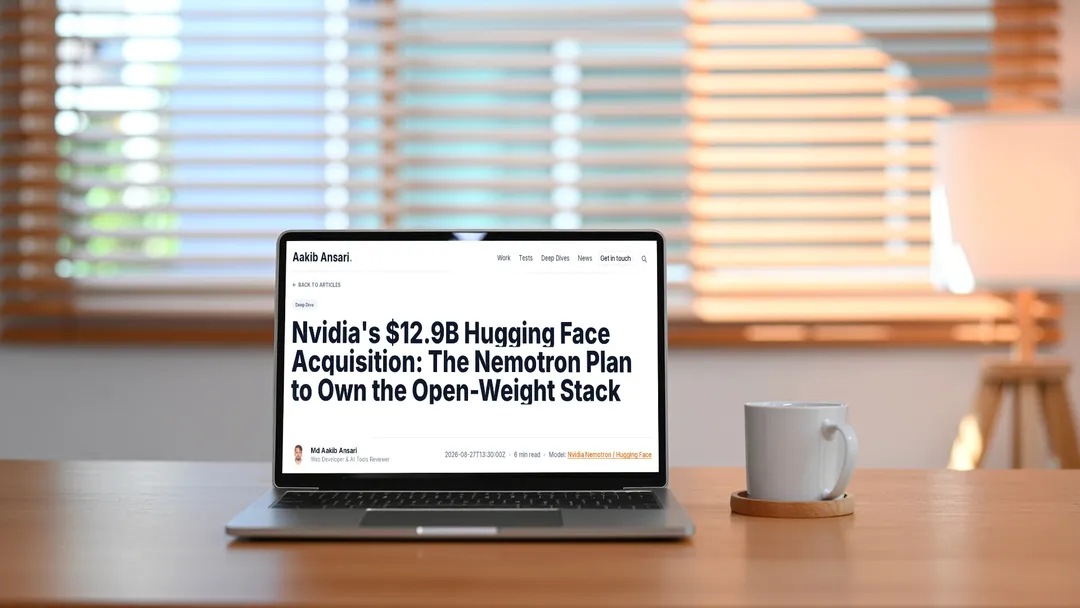
Late on August 26, 2026, The Information broke the defining M&A report of the year: Nvidia has agreed in principle to acquire Hugging Face, the open-source repository hosting over 13 million machine learning developers and hundreds of thousands of models, for approximately $12.9 billion.
While reporting from Business Insider and CNBC indicates that contracts remain in final negotiation stages and could face intense regulatory scrutiny, the strategic rationale has already recalibrated the competitive landscape. If closed, the deal represents Nvidia's largest acquisition in corporate history—nearly doubling the $6.9 billion paid for Mellanox in 2020—and positions the chipmaker to control both the silicon foundation and the primary software distribution pipeline of open-weight artificial intelligence.
Vitals & Transaction Overview
| Specification | Details | |---|---| | Target Entity | Hugging Face, Inc. | | Acquirer | NVIDIA Corporation | | Reported Valuation | $12.9 Billion USD (Source: The Information / CNBC) | | Transaction Status | Unconfirmed by principals; in active advanced discussions | | Developer Base | 13+ Million registered developers | | Strategic Vehicle | Nemotron Coalition & Open-Weight Ecosystem |
The Nemotron Coalition: Elevating Open Weights to Frontier Parity
The acquisition is closely coupled with Nvidia's broader "Nemotron Coalition" initiative—a consortium linking eight independent frontier research labs to co-develop open-weight architectures capable of competing directly with closed proprietary flagships like OpenAI's GPT-5.6 and Anthropic's Claude Mythos 5.
By controlling Hugging Face, Nvidia gains direct telemetry into global model downloads, community fine-tuning trends, and tokenizer preferences. Nvidia aims to leverage this distribution funnel to default enterprise workflows toward its CUDA-optimized Nemotron checkpoints (such as Nemotron 3.5 Lightning and open-weight agent models), ensuring that the rising tide of self-hosted enterprise AI remains inextricably linked to Nvidia compute clusters.
Community Reactions, Developer Trust, and the "GitHub Moment"
The prospect of Nvidia owning Hugging Face has drawn sharp parallels across the developer community to Microsoft's 2018 acquisition of GitHub. In analysis published by PCMag, industry commentators noted that while Microsoft largely maintained GitHub's platform neutrality, Nvidia's dual role as both hardware monopolist and marketplace owner introduces distinct conflict-of-interest risks.
Prominent open-source maintainers on Reddit's r/LocalLLaMA and the Hugging Face community forums raised immediate concerns regarding whether competing hardware accelerators—such as AMD's Instinct series, Google TPUs, or Intel Gaudi chips—will maintain first-class optimization within Hugging Face libraries like transformers, diffusers, and accelerate. Additionally, enterprise compliance teams are evaluating the legal implications of centralizing open model repositories under a single US semiconductor vendor currently navigating complex export control regimes.
Practical Blueprints: Preparing for Ecosystem Shifts
Enterprise engineering teams utilizing Hugging Face for model deployment and artifact storage can implement the following strategies to preserve architectural flexibility:
1. Multi-Hub Checkpoint Sync Blueprint
# Maintain dual-remote syncing to ModelScope and private S3 buckets
sync_config:
primary_hub: "huggingface.co/org/model-name"
mirrors:
- target: "modelscope.cn/models/org/model-name"
auth_token: "${MODELSCOPE_TOKEN}"
- target: "s3://enterprise-model-registry/model-name"
storage_class: "INTELLIGENT_TIERING"
schedule: "cron(0 2 * * ? *)"
2. Framework-Agnostic Serving Verification Prompt
Analyze the following multi-GPU deployment manifest. Verify that model weights and inference execution paths remain fully compatible with both vLLM on Nvidia GPUs and ROCm-accelerated alternative hardware without proprietary CUDA-only kernel locks.
The Competitive Horizon
Whether regulators in the US and Europe allow the transaction to proceed without significant behavioral remedies remains an open question. What is already clear is that open-weight AI is no longer a peripheral academic movement—it has become a strategic battleground where the world's most valuable tech giants are willing to deploy tens of billions of dollars to secure distribution dominance.